

For organizations
Create one governed application service for laboratories, engineering groups, and teaching environments on infrastructure your organization controls.
Finite-volume CFD for incompressible, compressible, and multiphase flows, plus heat transfer between fluids and solids, run with MPI across a managed cluster.
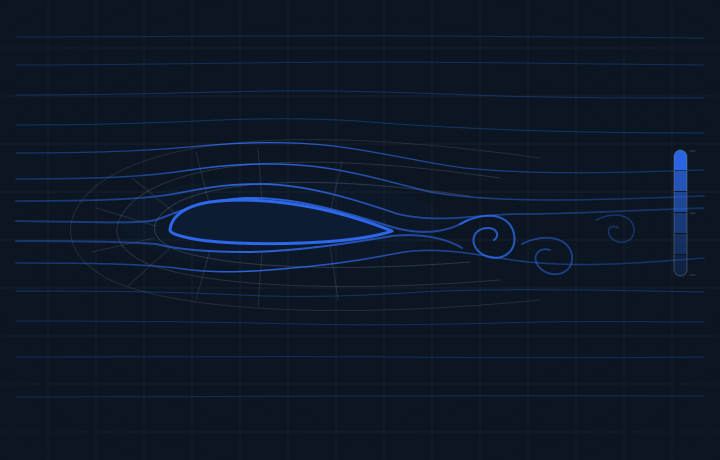
Provide research and engineering teams with approved applications and reproducible execution without asking them or your infrastructure team to maintain every software stack.
Create one governed application service for laboratories, engineering groups, and teaching environments on infrastructure your organization controls.
Choose an available application, configure a simulation, submit and track the run, review logs and status, and retrieve the recorded results.
Control approved applications and versions, licensing integration, access, resource quotas, execution policies, data location, and run history.
We package and validate applications, deploy the service on your OpenStack infrastructure, integrate licenses where required, and provide ongoing operations.
OpenFOAM is a finite-volume toolbox for computational fluid dynamics, developed in the open and used across academia and industry.
Rather than one solver, it ships a family of them. simpleFoam and pimpleFoam cover incompressible flow, and rhoCentralFoam and its relatives handle compressible regimes. interFoam solves free-surface and multiphase problems, and chtMultiRegionFoam takes over where fluid and solid regions exchange heat.
External and internal flows over vehicles, through ducts, and in rotating machinery, with simpleFoam and pimpleFoam covering the incompressible regimes.
Heat exchangers, mixing vessels, and heat transfer between fluids and solids in electronics enclosures, where chtMultiRegionFoam couples the two regions.
Marine hydrodynamics and other free-surface problems, solved with interFoam and the multiphase solver family.
Because the source is open, OpenFOAM is the usual starting point when a group needs its own solver, boundary condition, or transport model rather than a black box.
Cases are queued and decomposed across nodes with MPI, so a mesh that will not fit or finish on a workstation can run across the cluster instead.
Provision the managed cluster without submitting a simulation when inputs or the execution environment need preparation first.